Posts tonen met het label freesia. Alle posts tonen

2010-05-11

Fragrant flowers of my balcony

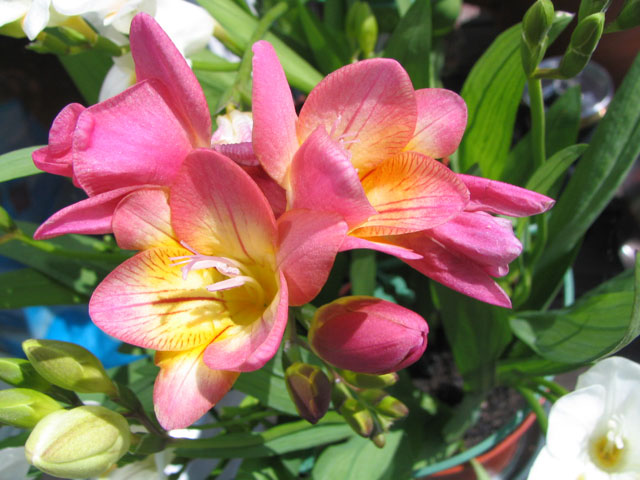
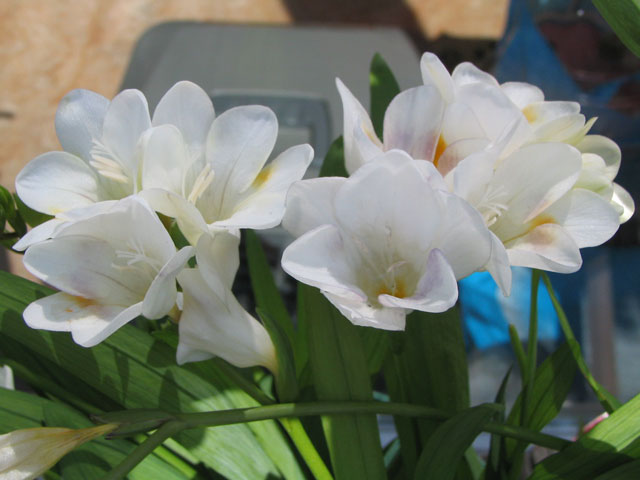
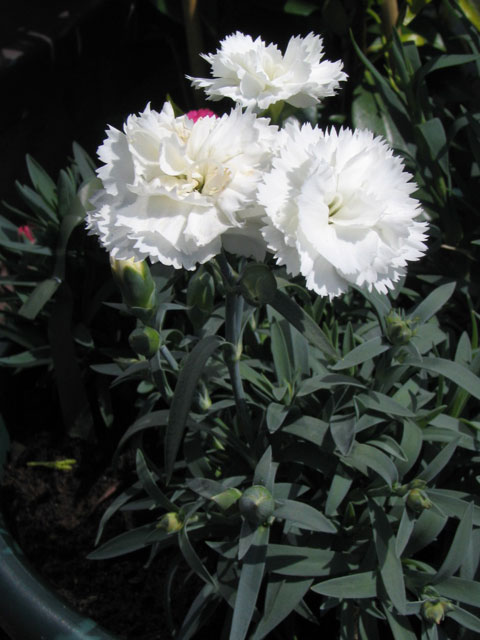
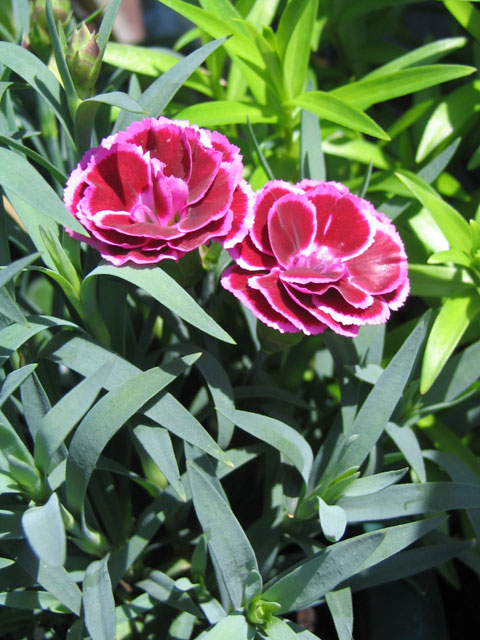
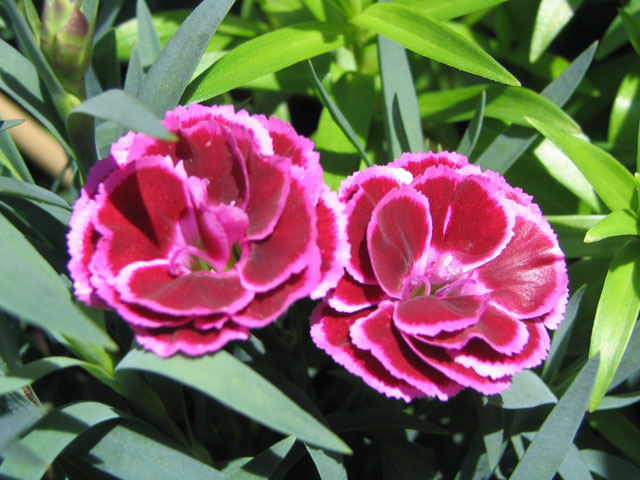
Last time I told you about Freesia I bought to investigate the smell and to use as a reference point in perfumery. Today we’ve got a couple hours of sun, so I decided to make a picture of my plants. Here are Freesias and Carnations. I hope the lilies and jasmine will be next to blossom.

Pink Freesia has a soft green smell with a fruity undertone. Reminds on a florist shop where you smell wet earth and all the shades of green coming from different plants.


White Freesia – the “florist shop” effect is present, but on the background. Dominating is a fresh smell with a peppery note.


Carnations have a surprisingly soft and quiet scent unlike their interpretations in perfumery. A spicy hart of clove with sweet vanilla note and a floral veil. White carnations are much more fragrant.


2010-05-09

Freesia lessons: a big frustration on purity

Well, perfumery can give you the greatest moments of pleasure when you smell a fragrance gently striking your emotions. But it also can be your greatest frustration when you can’t find a smell you are looking for. Learning perfumery gives you similar ambivalent feelings, but they seem to be stronger and occur more often.

Let’s take Freesia again. Well, I tried the smell of the sample formula from the PerfumersWorld. Nice, green, soapy clean, but it’s not a smell of a Freesia flower. Trying to improve it I made another version – less soapy and lees sharp in green notes, softer, but again… it’s not Freesia. And then a very simple solution – what if I just blend the materials found in the headspace of Freesia smell? About 15 drops of Linalool, 3 drops of beta-Ionone, 1 drop of alfa-Terpineoil and a drop of 10% Triplal as a green note (thanks to a perfumer from a perfumemaking Yahoo group for this wonderful idea). I was very surprised to smell a real Freesia flower very similar to the smell of a live flower, but… it lasted just for a couple of moments as later I smelled the harsh notes of linalool and alfa-Terpineol… So I faced a problem of quality of aromachemicals I used. The impurities making linalool harsh and alfa-Terpineol piney killed my Freesia accord. When you use those aromachemicals in a complex composition you can blur and mask the effect of impurities. But when you make a simple accord where those ingredients are crucial… you need the purest materials you can get.

The only problem here is the question – is it possible to find Linalool of such purity grade? Reading the description of Freesia from the PerfumersWorld I understand, that it looks like natural Linalool that occurs in Freesia is much more pure and radiant than a synthetic product available. Does it mean that there is no Linalool on the market that could concur the natural Freesia smell? It’s funny and frustrating. With the power of all the modern science and technology we can do many great things, we can precisely determine the components of the live flower smell, but we can’t reproduce it in the way the nature does using only earth, sunlight and water in less than a year…

Now I am sitting here and typing this message and by the random movements of the air I smell a real Freesia fragrance that is coming from a bunch of blotters with the residues of my experiments.

By the way, searching for information on Freesias I found an interesting discussion on Perfume of Life. Here is a quote: "In fact, there’s no freesia in any perfume in the world." -Chandler Burr. The full text you can read here: http://www.chandlerburr.com/articles/25tghost.html (you have to “download” the article to read it).

And for those who didn’t know yet – Nicole Kidman makes her own perfumes. Freesia was one she made. He doesn’t share the secrets of her craft, but you can watch two interviews where she mentions her hobby. In the first one it’s in the begin and in the last one at the end. Have fun!


2010-05-08

Freesia quest II: technical details on smell

See the first part about Freesia here

There is something very special in Freesia fragrance in perfumery – it doesn’t really has a “key” ingredient. Unlike eugenol for carnation or rose alcohols for rose or benzyle acetate and indole for jasmine. PerfumersWorld course mentions linalool to be that “key” for Freesia. But linalool is also a very common ingredient in many other raw materials – bergamot, rosewood, lavender to mention a few. It’s also often used in floral bases to give freshness. I guess it explains the problem of Freesia note in perfumery – consisting mostly of linalool it can easily become dominated by other components, loose its character and just turn into a fresh note.

To my nose the white Freesia I bought does smell like pure linalool with a peppery nuance. A perfumer in a perfumemaking group where Freesia accord was discussed also mentions that Freesia smells like linalool, but without a harsh part of it. A chemical analysis of the smell shows about 80% linalool to be the major constituent of live Freesia fragrance (it increases up to 90% in a picked flower).

Another important constituent of Freesia fragrance is beta ionone. It’s found at the amount of 3% in the fragrance of a live flower (together with 3.7% of dihydro beta ionone, 5,4% 4-oxo beta ionone and 2,2% 4-oxo beta ionol). Michael Storer also mentions that smell of beta ionone is very close to the smell of Freesia. I tried his suggestion and I can say it’s true – 1% beta ionone solution on the blotter start to smell very close to my colored Freesia flower in about 30 mins (but not right from the beginning).

Another important constituents of Freesia fragrance are Terpineol 4% and traces of green molecules (like cis-3-hexenyl butyrate and beta cyclocitral). So, it looks like the formula of Freesia is made of linalool with a little bit of beta ionone and traces of green nuances. A good point to start!

The sample formula from the PerfumersWorld produces very clean, fresh and green Freesia note. The presence of aldehydes and sharpness of green notes make it soapy. It would be a nice base to use in body care products. It can be also a good fresh room scent reminding on spring. But I guess I have to work on it a little bit and try to make it closer to the smell of the flowers I bought.

Freesia quest: smell and perfumes


Picture: Yellow Freesia Bloom found at teleflora.com

It was very exciting to receive my new unit from the PerfumersWorld – it was all about flowers – about 18 sample formulae to make, investigate and to play with, so I can learn to understand the soul of each of floral note in perfumery. The funniest thing I discovered that there are flowers I don’t know at all… like freesia.

Well, of course I’ve heard about it and met in pyramids, but… I’ve found I don’t remember how it looks like or how does it smell. That’s a good time to learn about this fragrance. And you know, Fortune always helps to those who follows their heart and is eager to discover. May be that’s why the next day I found folder from the local garden shop telling me they had fragrant Freesias on sale, so I went there to meet my housework and came home with two freesias – a white one and pink with yellow.

The first surprise was to discover that they smell different. The white flower has a fresh fragrance with peppery notes and the colored one smells very green – just like at florist shop – a mixed fragrance of plants, leaves and stems. It’s fresh and rather soft green unlike the sharp smell of fresh grass or crushed leaves. It’s funny to find how many varieties of flowers in shapes and colors it produces… and the tough thing is that the smell varies as well. So, what would be the reference?

PerfumersWorld in their course puts Freesia among “Light Green Floras” together with Muguet and Cyclamen. I also found that in one classification it was listed under the Tuberose-Narcissus group. Well to my nose it’s green, but less sharp than hyacinth and less poisonous than narcissus. I guess “light green” or “fresh green” would be the nice place for Freesia.

It’s funny to find that there is very little information on Freesia in perfumery books or magazines. Well, I can understand that – there is no essential oil or absolute available. Some sources mention that Freesia have been a fantasy bouquet in earlier fragrances. They also mention that it was used for extracts or as modifier.

Searching for Freesia fragrances I found that most of the soliflores called Freesia are made by brands specializing on Bodycare fragrances (like Crabtree&Evelyn, The Body Shop, Bath&Body Works) – I guess the freshness of Freesia note makes it very suitable for such products. But I also found a couple of niche Freesia fragrances – “Orfésia” van Diptyque and “Musc et Freesia” by E.Coudray. Fragonard, Borsari and Demeter also have their Freesia versions. Unfortunately I haven’t smell any of them, so it promises a lot of sniffing, discovery and surprises.

Browsing through the Basenotes discussions I also found the following fragrances might be interesting to try: Miracle by Lancome, Red Door by Elizabeth Arden, Rush by Gucci, Cerruti 1881 pour femme, Eternity by Calvin Klein, Kenzo Parfum d’Ete, So de la Renta, Beige van Chanel, Paul Smith Woman, Sun Moon Stars van Lagerfeld, New York Fling by Bond No. 9, Antonia’s Flowers, Pleasures by Estee Lauder, Allure by Chanel, L’Eau d’Issey by Issey Miyake, JPG Classique, Dolce & Gabbana Woman, Ralph by Ralph Lauren, Incanto Dreams by Salvatore Ferragamo, Balmy Days and Sundays by Inele. I haven’t checked those fragrances and it would be interesting to search for Freesia in them. But you are also welcome to share your experiences and suggestions.

Unfortunately I couldn’t find interesting facts or inspiring myths and legends related to Freesia. This flower seem to have a short history as it’s cultivated as a cut flower only since the begin of the XIX century. It was named in honor of Friedrich Heinrich Theodor Freese, a German physicial from Kiel. His friend, a plant collector Christian Friedrich Ecklon has proposed the name.